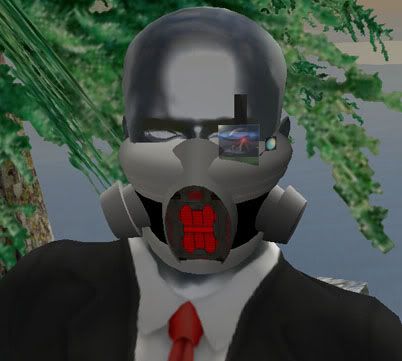
zombified
Originally uploaded by Gabe Lippmann
Look, zombies! Run!
What would SL be without a cube on an abandoned neighboring parcel that is spewing particle zombies and moaning sounds?
If you can't beat 'em.....
Look, zombies! Run!
What would SL be without a cube on an abandoned neighboring parcel that is spewing particle zombies and moaning sounds?
If you can't beat 'em.....

I'm finding an uncomfortable peace with the dealership loaner car I'm currently using. However, this push-button ignition is something I don't really appreciate, much less want.
There already exists a riot of sensors, knobs, buttons and levers that do all manner of strange things. Each one removes the driver just a little farther from actually controlling the vehicle. This ignition button just feels wrong. You press it and wait while the car does its thing. Personally, I like turning the key. It's like checking the pulse.
What goes on in today's vehicles seems lifeless. They unlock themselves as you approach (and some even start up). They sense rain and wipe away without driver consent (forced windshield wiping! call the authorities). They turn the headlamps on and off and check their own tires. They park themselves. Maximum Overdrive, anyone?
I'm not even going to get into the unexpected, odd sensation of cold air blowing on your ass from a temperature regulated driver's seat (particularly when you were not expected it).
The result was typical shortsighted behavior and avarice fueled decision making from all parties. Consumers took full advantage of rates and leveraged themselves to the hilt. Consumers assumed debt well beyond their ability to shoulder in the event of a rate shock. Institutions took the opportunity to lower standards and bleed the subprime consumer while they could, while creating layer upon layer of financing that obscured the final investor from knowing what real values were. Attempts to push the long-term rates higher (and increase mortgage rates as a result) were foiled as investors' risk-return tolerance became suspect and foreign investment in U.S. Treasuries remained high. At the same time, non-regulated lenders became major players (banks were no longer the dominant lenders), loan-to-value ratios increased to untenable levels and borrowing requirements eased. In 2006, almost half (45%) of subprime loans were made to borrowers without fully documented incomes (and often, overstated credit worth). Bad loans were not in evidence, but mainly due to the ease of refinancing, and not due to any inherent strength in credit quality across the land.
Easy-money greed bled into the Leveraged Buyout business and down to the investors, including your next-door neighbor and your high school teachers' pension fund. With everything moving along at breakneck speed and high-risk investors raking cash, the disciplined, diversified investor was left wondering how they could justify staying out of the deep end. The con man needs a willing mark.
Lessons are always learned, but not often remembered.
KING: We welcome Jake Brown. And Dario Franchitti remains with us. Dario, of course, won the Indy 500 and had that accident going 250 miles an hour in Michigan on Sunday. Jake had this last Thursday at the X Games here in Los Angeles.
You brought the shoes with you, right?
JAKE BROWN, PROFESSIONAL SKATEBOARDER: Yes. These are the shoes that flew off my feet.
KING: Now what happened? Well, all right, what happened, Jake?
BROWN: I landed a 720 over the gap. There's two different obstacles on this contest piece and a 720 is two rotations. It shows the footage right there. And then I'm coming up the quarter pipe and I'm off balance. I was trying to cut over to the right and then cut back to the left to give myself more room to move on the quarter pipe part where the accident happened. And I was off balance and the G- forces; everything else combined to make me squat to the board and then shoot me out to the flat, as you can see.
KING: Did you know you were trouble?
BROWN: Yes. By the time I got to the top of the ramp, I knew I was in big trouble.
KING: How badly were you hurt?
BROWN: I think there was a lot of adrenaline at first because I wasn't really that hurt right away. I felt like...
KING: What's your injuries now?
BROWN: I've got a fractured wrist, a fractured vertebrae and a bruised kidney -- I mean bruised liver and lung and just...
KING: How long have you been skateboarding?
BROWN: ...some crazy whiplash. About 20 years.
KING: Why?
BROWN: It's great fun. I mean once I picked up a skateboard, it's all I ever wanted to do.
KING: Where are you from?
BROWN: Australia.
KING: Can you make money skateboarding?
BROWN: Yes, yes. That's what I do it to make money. So...
KING: I mean do you make it at events like at X Games, you make money?
BROWN: You make money from sponsors and then events and demonstrations and...
KING: You brought this hat. It says "Blind." Is that a company that makes skateboards?
KING: Yes. That's a skateboard company. I ride for them.
KING: Dario, what do you think of what Jake does?
FRANCHITTI: I couldn't actually watch the accident, Larry. I started to see it happening and I had to turn away. It's scary looking. I mean I have all that protection around about me and with the car and with the formal structures and there's Jake with his skateboard and, you know, not much else. So I think he's incredibly brave.
KING: Jake, what do you think of what Dario does?
BROWN: Well, he's going quite a bit faster than me. It's just we're in two different worlds, you know. And then I've got much respect for what he does as well.
KING: All right, when you're going up, what's the key to skateboarding? Do you do things that other guys don't do? I mean are there certain jumps that other guys don't do?
BROWN: A lot of people have different tricks, like signature tricks and stuff.
KING: What's yours?
BROWN: Basically for videos you film -- when you film a video about it, it usually takes about a year or so to film...
KING: To film a video?
BROWN: Yes.
KING: A year?
BROWN: And then it'll be like a two-minute segment for each rider or whatever. So you'll just be there, you know, five days a week filming, filming, filming until you get that two minutes at end of the year. And it's usually a bunch of tricks that haven't been done or just, you know, some unusual or enjoyable stuff like -- this is from a video, our last one, video, "What if?"
KING: Boy, that's pretty great stuff.
BROWN: Yes.
KING: How important is the board?
BROWN: The board is one of the main things. The board, the shoes, the wheels, it all comes into play. You want to feel comfortable with your entire setup.
KING: I asked Dario if you can teach his sport. Can you teach yours?
BROWN: Yes, definitely. I mean if kids are into it, you can definitely point them in the right direction on what they are doing wrong, you know what I mean.
KING: The front of it is the exhilaration of going up?
BROWN: Yes. It's fun being weightless until you catch up to gravity.
(LAUGHTER)
KING: Just ahead, his car went airborne at more than 300 miles an hour but he's here to tell the story of why he survived and why he keeps on racing. That's next.

IBWA Response to Editorial inThe New York Times
Bottled water is a safe, healthy, convenient beverage that consumers choose to stay refreshed and hydrated. The International Bottled Water Association (IBWA) believes it is important for consumers to have the facts about the bottled water industry's outstanding record of environmental stewardship, safety and quality, and role as a bottled beverage of choice.
- Any actions that discourage the use of this healthy beverage choice are not in the public interest.
- The bottled water industry has an outstanding record and solid commitment to environmental stewardship and is a leader in the food and beverage industry in reducing its environmental footprint, while at the same time delivering the healthful value of bottled water to thirsty consumers.
- If the debate is about the impact of plastic packaging on the environment, a narrow focus on bottled water spotlights only a small portion of the packaged beverage category and an even smaller sliver of the universe of packaged products
- Despite their popularity, PET water bottles accounted for less than one-third of one percent of all waste produced in the United States in 2005.
- Any efforts to reduce the resources necessary to produce and distribute packaged goods-and increase recycling rates--must focus on ALL packaging. Any other approach misses a real opportunity to arrive at a comprehensive solution to protecting and sustaining the environment.
- Pitting bottled water against public drinking water confuses consumers who make bottled water their beverage-of-choice.
- People recognize the importance of water consumption for hydration and refreshment and that should be encouraged-whether it is from bottled water or
tap water. When faced with an array of bottled drink choices, consumers often choose bottled water because it does not contain calories, caffeine, sugar, artificial colors, or other ingredients they wish to avoid or moderate.- When it comes to bottled water or tap water, most people drink both, depending on the circumstances.
- Bottled water is a healthy beverage produced by an industry that supports and relies on safe, quality ground water resources as well as municipal water systems and is are interested in strengthening, not undermining, municipal water sources.
- Bottled water consumption has nothing to do with tap water infrastructure funding or drinking water system improvements. It is about beverage choice, available to consumers in all walks of life who choose, or rely upon, bottled water for refreshment and hydration.
As a consumer and an Earthling, I find this response to be a genuine failure. It seems an obvious attempt to obscure the issues raised by the eco-warriors and I'm insulted that they would think anyone would be mollified by this statement. They could have at least proof read the damn thing.
When are they going to start oxygen mining and selling it back to us in spiffy branded tanks? I suppose before that fantastical outcome, the current breathable air supply would have to be spoiled to the point of creating air quality concerns.....